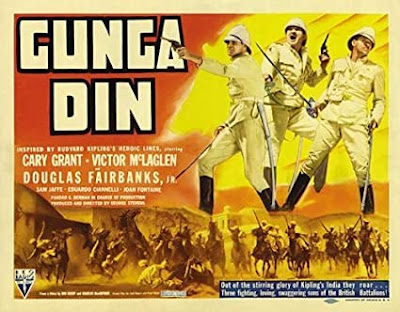
Over the last few years, I have been digging deeper into the classics. It has been a fun ride. I've been thrilled to find that some of my bucket list movies, like Best Years of Our Lives and Bad Day at Black Rock truly live up to their reputations. I've also enjoyed discovering some new gems I knew nothing about, like The Train, or re-evaluating old classics I had not seen in decades, like Double Indemnity.
Gunga Din falls into that latter category. I had not seen the film since high school, at the peak of my Cary Grant craze (he remains one of my favorites still today). But I do remember being vaguely disappointed by the film, and I couldn't quite remember why. Gunga Din has an excellent reputation. It was part of that magical year in 1939, which many scholars consider the best in Hollywood history and includes the releases of Gone with the Wind, Love Affair, Mr. Smith Goes to Washington, Wizard of Oz, Wuthering Heights, Another Thin Man, Stagecoach, Ninotchka, Rules of the Game, The Women (and the list goes on and on). Even with that competition, Gunga Din was still the sixth highest grossing film of the year. It did get a bit lost at the Oscars, only getting one nomination for Cinematography, but that is understandable given the pedigree of that year.
Loosely adapted from the famous poem by Rudyard Kipling, Gunga Din is the story of three British sergeants stationed in India during the 1880s: tough as nails MacChesney (Victor MacLaglan, The Informer), the roguish Cutter (Cary Grant, North by Northwest) and the romantic Ballantine (Douglas Fairbanks, Jr., Prisoner of Zenda). The three find themselves facing off against the brutal Thuggee cult that was gaining power in India at the time. The film can be broken into three distinct chapters. In the first chapter, the sergeants have to escape from a town after a Thuggee ambush, the second chapter is about MacChesney and Cutter trying to keep Ballantine from retiring and getting married, and the third chapter involves the discovery of a golden temple and the inevitable face-off against the Thuggee army. Oh, there is also a regimental water carrier named Gunga Din (Sam Jaffe, Ben Hur) who happens to show up occasionally. And that gets into one of the problems about the film, but more on that later.
There is a lot to like in Gunga Din. MacLaglan, Grant and Fairbanks, Jr. have terrific chemistry. The ambush sequence in the first chapter of the film is a lot of fun, full of swashbuckling and slapstick humor that is genuinely funny. The screwball comedy atmosphere continues in the second chapter. There are some true laugh out-loud moments in this sequence, especially at a banquet to celebrate the upcoming marriage of Ballantine and Emmy (Joan Fontaine, Suspicion). But the fun balance that director George Stevens is trying to strike just falls apart in the last story. The film begins to grow pretty dark when the three sergeants and Gunga Din run up against the full Thuggee army, but at the same time, the movie refuses to completely let go with the breezy, comedic banter between the three actors. High tension and humor is always a difficult blend to strike, but it can be done; however, the tones are completely at odds here. And when the film does grow deadly serious, which the plot requires it to do at one point, it's like nothing else in the movie. It suddenly becomes a serious wartime drama, and that just doesn't vibe with everything else we've been watching up to this point. It's also at this point that the filmmakers suddenly remember, "Oh, wait, this movie is called Gunga Din!!!" and suddenly need to think of something for the character to do which vaguely resembles the Kipling poem the film is based on.
Why is this movie called Gunga Din? The movie is only really interested in the playful antics of Ballantine, Cutter and MacChesney, and poor Gunga Din is just an after thought for most of the film. He appears in a few scenes to learn about marching from Cutter or to chastised by MacChesney, but generally, the movie just isn't that interested in poor Gunga Din. I know some defenders will claim that this is the point of the movie, that characters in the film don't give Gunga Din enough credit, so this is all part of the film's theme. And I would respond by saying those folks are actually giving the movie too much credit. It's not that smart. It is certainly business savvy and pragmatic. Look, Cary Grant, Victor MacLaglan and Douglas Fairbanks, Jr. were big stars. Audiences were coming to see them, so of course the movie is going to focus on them. But in that case, don't call the movie Gunga Din and shoehorn a subplot into the story that the filmmakers don't seem to care about. It just hurts the movie.
Which is a shame, because a movie that paid a little more attention to the Gunga Din character would have been really interesting, and certainly made the climactic scenes all the more moving. The movie just completely lets him down, which is a strange thing when the film is named after the character.
Admittedly, viewed with modern eyes, it can be uncomfortable at times to watch Gunga Din because of the brown-face and the social and racial attitudes of the main characters. I was mostly bothered by the number of times MacChesney threatens to physically hurt Gunga Din. But a minor spoiler here, the film does try to address this at the end when they break out the famous last lines of Kipling's poem: "Though I've belted you and flayed you / By the livin' Gawd that made you / You're a better man than I am, Gunga Din." While these lines are spoken, the camera lingers on MacChesney for a brief moment, allowing us to take in a guilt ridden and anguished face. That guilt is interesting and I wish it had been further explored. But I think the problem with this goes back to the film's tone. MacChesney's threats earlier in the film are played for laughs in typical screwball comedy fashion. We're not supposed to be horrified by them. So is the ending a disingenuous apology? Or is it again just part of shoehorning the poem into the film that has sort of ignored it up to this point.
At the end of the day, it's just an example of how the film is at odds with its self. Despite a balancing act that succeeds for large stretches of the film, director George Stevens just can't interweave the comedic tone with some of the more serious themes that are hinted at. I guess the best way to review the movie is that many of the individual pieces are terrific, but they just don't add up to a sum that is satisfactory. I know the film is considered by many to be a classic, but I just couldn't help but be disappointed.
MVP:
I'm not going to lie, this is an easy one. I might be biased, but Cary Grant is almost always going to be my MVP in anything he's in. But even objectively, I think he is probably the clear favorite here. To be fair, Grant does have the most memorable role. Initially he had been considered for the romantic lead, Ballantine, but Grant recognized that Cutter was the flashier part. Grant leapt at the chance to embrace his rascally Cockney roots, and you can tell he's having a grand time. Fairbanks, Jr., MacLaglan and Jaffe are all good and have their moments, but Cary Grant's highlights shine the brightest. The moment where he pours the elephant medicine into the punch at the party...ah, it's a master class of comedy. Sure, his character does some things in the last third of the film that I don't like, but to be fair, there's not much of anything I like in the last third. So I won't count that against him!
BEST LINE:
I have to give an honorable mention for this movie. I have always liked this line from Ballantine when MacChesney and Cutter are arguing.
Ballantine: You displease me greatly, and I ignore the both of you.
But the real winner is when Ballantine announces his retirement. Admittedly, this exchange wins because of the performances of the actors, and not necessarily because of the writing.
Ballantine: I'm leaving the service.
MacChesney: Leaving the service??!?!
Ballantine: That's right. I'm getting married and I'm going into the tea business.
Cutter: Tea business!?!?!?!
And yes, on paper, this line is not funny. But when you see the performances, I have no doubt that everyone will agree this is the best line of the movie. The sheer horror and disgust on Cary Grant's face when he yells "Tea business?!?!" is comedy gold.
TRIVIA:
There have been multiple stories about Cary Grant's casting as Cutter. Fairbanks, Jr. claimed that the roles were initially reversed, and that he had initially been cast as Cutter because of the character's similarity to the types of roles his father had become famous for playing. Cary Grant really fought for the part, though, so finally director George Stevens decided to flip a coin, and Grant won. Fairbanks, Jr. sounded regretful in the telling, like he had missed out on what could have been his best role.
According to George Stevens' biography, this story isn't true. Stevens was originally thinking of a comedian named Jack Oakie for the role of Cutter, but was happy to give it to Grant when he requested the role. And it was at this point that they brought in Fairbanks, Jr. According to Ben Mankiewicz, it was actually Grant who recommended Fairbanks, Jr. for the part. If that's true, then I think it's pretty low for Fairbanks, Jr. to claim that Cary Grant stole his part!

